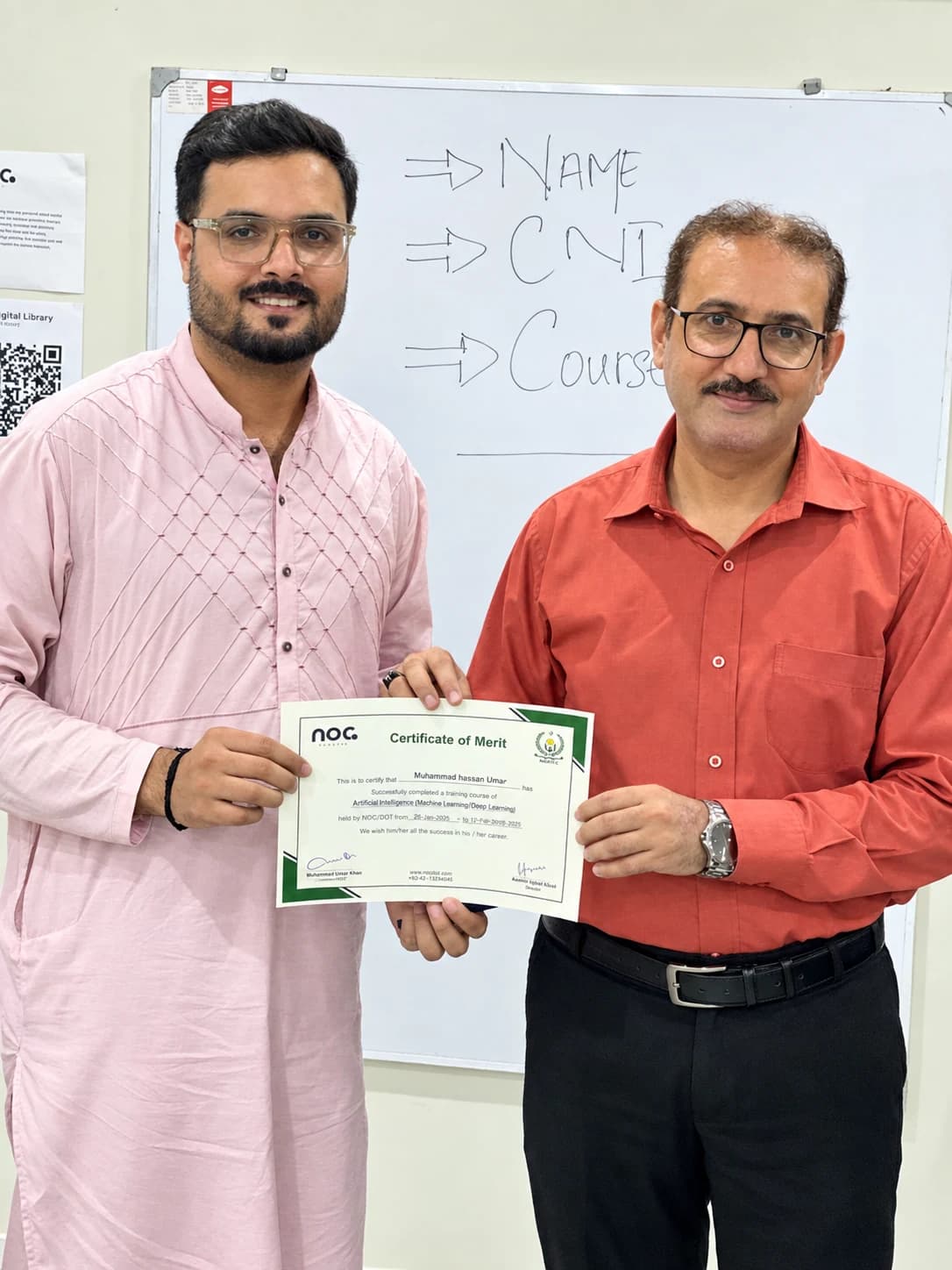
Completing My AI/ML Course: What I Learned with Sir Nadeem
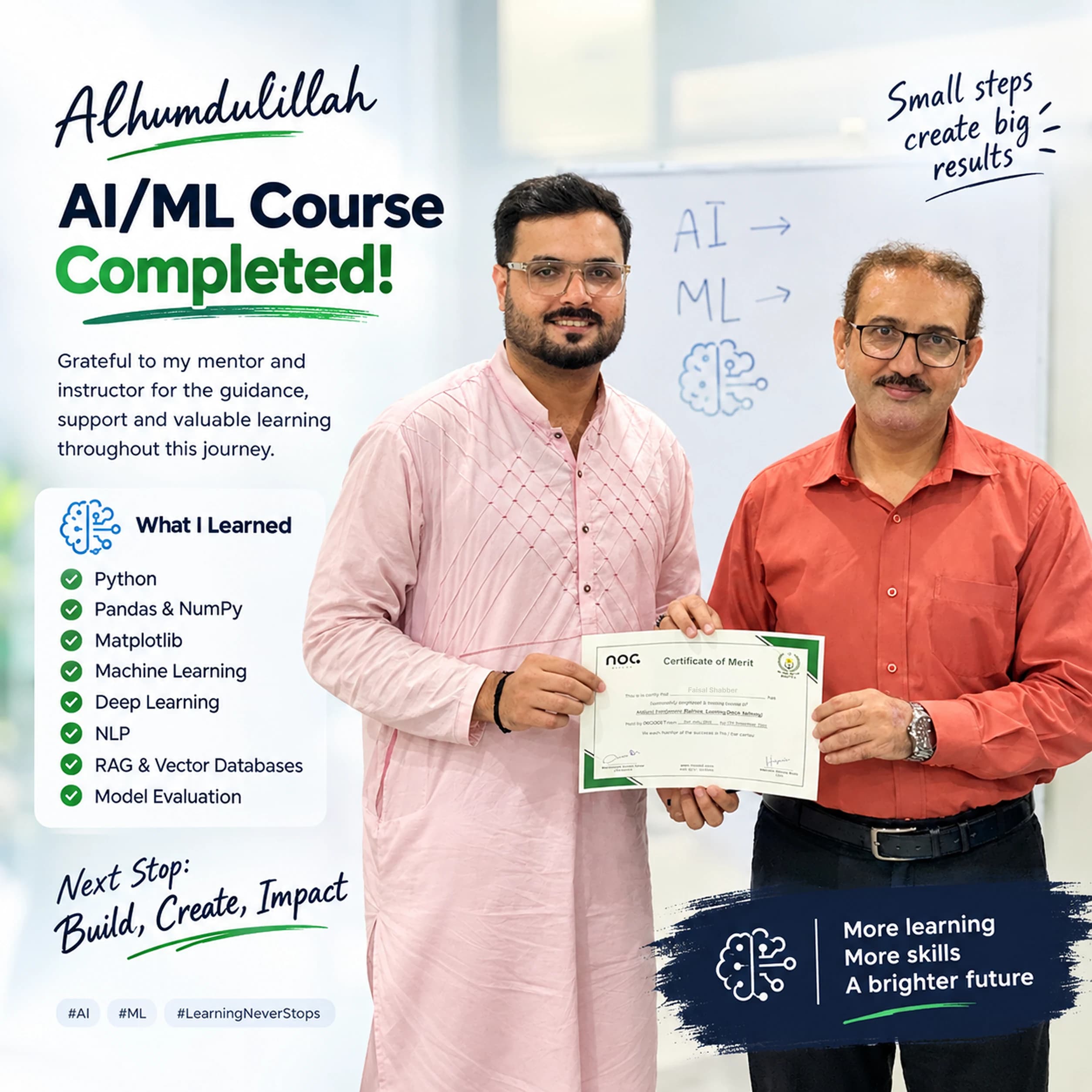
Alhamdulillah, I recently completed an Artificial Intelligence and Machine Learning course with Sir Nadeem. I am grateful to him for his guidance, support, and the way he helped make a wide subject easier to approach one step at a time. Completing the course is an important milestone in my learning, and it has given me a stronger foundation to keep exploring AI/ML.
The course covered a broad path: preparing and understanding data, learning how machine learning models work, exploring language technologies, and seeing how retrieval can connect language models with external knowledge. Here is a closer look at the topics I studied.
Python and working with data
Python provided the programming foundation for the course. I studied Pandas and NumPy for working with datasets: organizing tabular data, inspecting values, performing numerical operations, and preparing information for analysis. These tools help turn raw data into something that can be explored systematically.
I also studied Matplotlib, which makes it possible to visualize data and communicate patterns through charts. Visualizing a dataset can reveal distributions, relationships, and unusual values that are difficult to notice by looking at rows of numbers alone.
Machine learning and deep learning
The machine learning topics introduced how models learn patterns from data and use those patterns to make predictions. I learned to think about the full process: understanding the problem, preparing relevant data, training a model, and checking how well it performs.
The course also covered deep learning, a branch of machine learning built around neural networks. Studying it helped me understand where layered models fit into the wider AI landscape and why they are used for complex tasks involving images, audio, and language.
Natural language processing, RAG, and vector databases
Natural Language Processing (NLP) focuses on working with human language. I explored how AI systems can process and represent text, creating a foundation for applications such as text classification, search, and conversational interfaces.
I also studied Retrieval-Augmented Generation (RAG) and vector databases. RAG combines retrieval with generation: relevant information is found from a knowledge source and then provided as context to a language model. Vector databases support this workflow by storing and searching representations of content by semantic similarity. This was a useful introduction to how AI applications can answer questions using a specific collection of information.
Model evaluation and what comes next
A model's output should not simply be accepted because it looks plausible. Model evaluation is the process of checking performance against suitable measures and examples, understanding limitations, and looking for cases where results may be unreliable. It is an essential part of building AI systems responsibly.
This course gave me a structured introduction to Python, Pandas, NumPy, Matplotlib, Machine Learning, Deep Learning, NLP, RAG, vector databases, and model evaluation. I am thankful to Sir Nadeem for teaching and mentoring me through the journey. I plan to keep practicing these foundations and gradually apply them in small, useful experiments alongside my frontend and full-stack development work.

Special Thanks
My heartfelt thanks to Sir Nadeem for teaching and guiding me throughout the AI/ML course, and to Haris Bhi and Shahid Bhi for supporting me throughout this journey. I truly appreciate their encouragement, time, and belief in me.
Grateful for the learning, the people, and the memories made at NOCDOT.
NOCDOT Memories